

On May 21, 2026, at the Veronesi La Torre Hotel in Dossobuono, we initiated RE-NEXT, Regesta Group’s first Customer Convention: an afternoon of discussion dedicated to theevolution of the modern enterprise, the role of AI-powered digital technologies, and the need to integrate innovation, method, and process knowledge into a sustainable growth path.
We designed this appointment at a decidedly unusual time in history from the perspective of innovation, with one goal in mind: to explore with our clients how new digital technologies can integrate stably into enterprise architecture to evolve complexity into a more orderly, robust, and governable structure.
RE-NEXT, in short, is a shared moment intended as a convention designed to understand how AI and digital technologies can enter the enterprise in a stable way, with a logic of architecture and not of mere experimentation.We designed this appointment at a historical moment that is decidedly unusual from the point of view of innovation, with one goal: to explore together with our clients how new digital technologies can be stably integrated into enterprise architecture, to make complexity evolve into a more ordered, solid and governable structure.
The agenda included an initial plenary session dedicated to the design of business evolution, in-depth tracks on application scenarios relevant to managers and decision makers, a concluding plenary with the contribution of Father Natale Brescianini, and a final networking cocktail dedicated to the exchange of perspectives among participants, specialists and Regesta network.
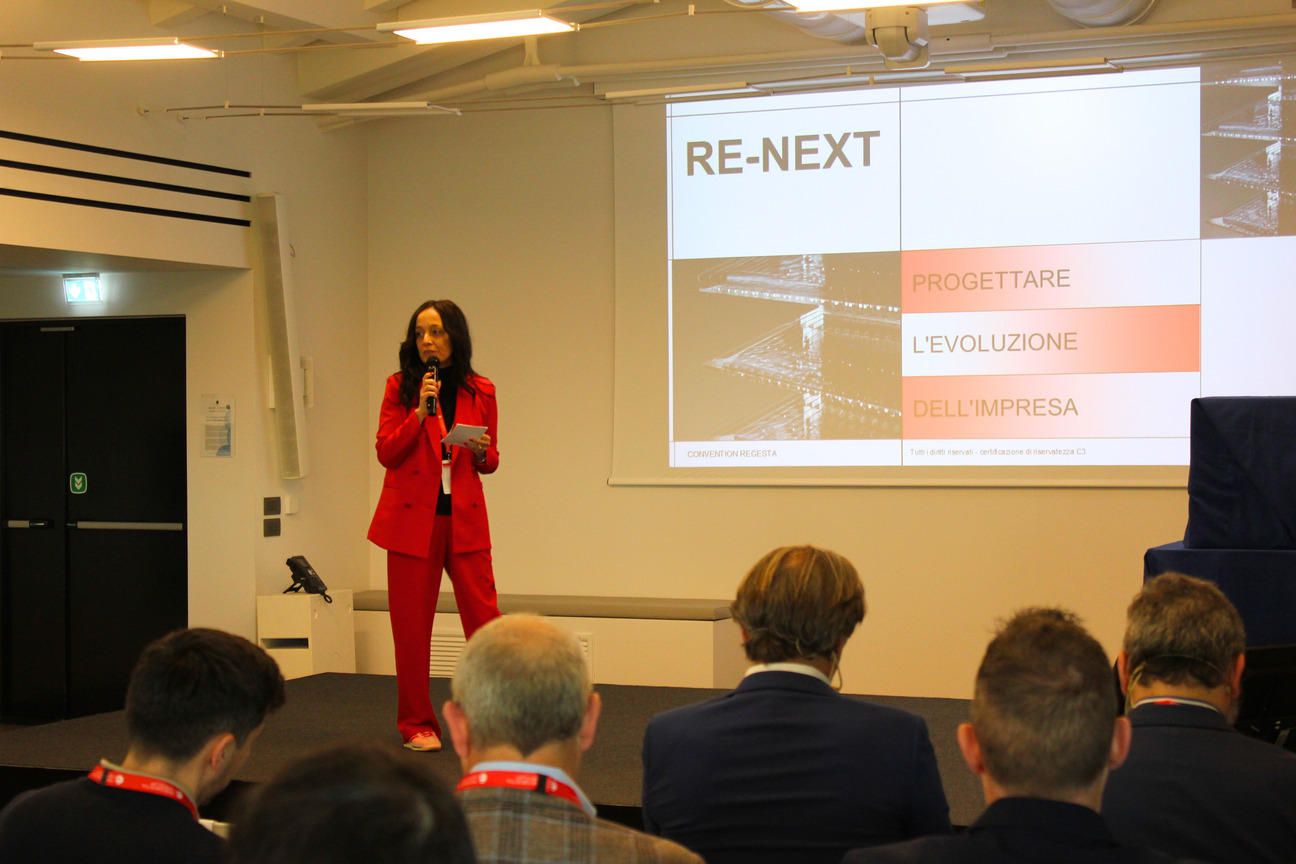
From ERP to the integrated enterprise
With RE-NEXT we wanted to confirm a shift that directly affects our evolution: enterprise digital can no longer be read only through the lens of ERP, although ERP remains one of the foundational elements of enterprise information architecture. In recent years we have grown and changed, expanding skills and solutions beyond ERP, with which we were born and for which we are best known. We also told this in our pre-event communication, presenting RE-NEXT as an opportunity to share vision, experience and new opportunities with our customers.
The issue, however, has never been the technology itself. The focus is on how technologies enter processes, connect to data, support decisions, and become part of a more effective operating model. In a business environment where systems, applications, departments and information sources often tend to proceed separately, the value of digitization depends on the ability to build stable connections.
This is where method takes on a crucial role. Without an architectural vision, even the most advanced tools risk remaining isolated elements. That’s why we built RE-NEXT as a concrete discussion on how to move from adopting individual solutions to building a more responsive business system capable of turning data into decisions and innovation into operational value.
This perspective directly affects manufacturing, industrial and service companies that have to manage complex processes, articulated supply chains, sustainability needs, fragmented information assets and growing expectations on the use of artificial intelligence on a daily basis. In these scenarios, technology produces value only when it is linked to process knowledge and the ability to accompany people in change.
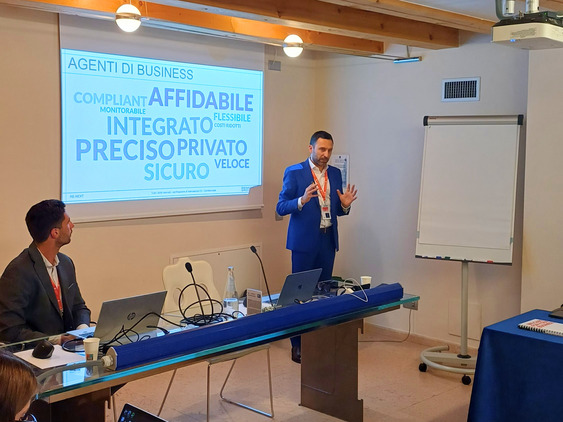
The agent enterprise and the value of knowledge
One of the most significant in-depth tracks was devoted to the agent enterprise, knowledge management and AI Digital Workers. We chose this theme because it intercepts a very concrete need: many companies have a large information asset, distributed among documents, procedures, management systems, individual expertise, operational experience and relationships between departments. However, this wealth is often not readily accessible, is not uniformly structured, or depends on the availability of individuals.
With the concept of the agentic enterprise, we wanted to propose a change of perspective: to transform corporate knowledge into action, through tools capable of supporting users, automating repetitive tasks, retrieving relevant information, and protecting know-how.
The value of AI Digital Workers lies not in replacing human expertise, but in making it more available, more reusable, and more integrated into operational flows.
This is an important point because it shifts the discourse from automation as labor reduction to automation as organizational empowerment.
In this sense, training assumes an essential role. The adoption of artificial intelligence requires trained users, clear processes, defined responsibilities and a corporate culture capable of distinguishing between useful automation, decision support and simple technological experimentation. During the event, we wanted to reiterate a clear guideline: AI produces value when it is designed within an understandable, governed and measurable organizational context.
Business AI, data and decisions: the operational center of change
Another axis of the event was the relationship between Business AI, SAP and integrated processes. We approached Business AI as a technology that must enter processes natively, securely and consistently with the enterprise application architecture. This approach brings the discussion to an often underestimated point: business artificial intelligence cannot function properly unless it rests on reliable data, consistent processes, and integrated application architectures.
An AI model, no matter how evolved, produces limited results when fed with fragmented, duplicated, inconsistent, or context-free data.
That is why we have devoted a specific space to Data Strategy, linking the topic of data integration to decision making. A robust Data Strategy makes it possible to reduce information silos, harmonize sources, generate consistent information assets, and make data effectively usable by business management. The issue is not just about the availability of dashboards or reports, but the ability to build information that is governed, traceable, and linked to processes.
It is from this foundation that more reliable decision-making models, more relevant predictive analytics, and truly useful automation tools can emerge. For many companies, the move toward more data-driven models is precisely about reorganizing the relationship between data, processes, and decision-making responsibilities, rather than adding another layer of technology. The goal is to reduce operational ambiguity and improve the quality of choices.
Finance, sustainability and value governance
During RE-NEXT we also addressed the topic of value governance, linking management control, finance and sustainability. Data fragmentation and the persistence of manual processes can reduce a company’s ability to accurately read its financial, operational and ESG performance. Instead, the integration of these dimensions makes it possible to treat financial soundness, sustainability and governance as parts of the same decision-making system.
This perspective is particularly relevant for companies facing increasing demands in terms of transparency, reporting, planning and control. ESG data, for example, cannot be managed as a separate set of indicators required only for compliance purposes. To become useful, it must dialogue with economic, industrial and organizational data.
The same applies to management control: the ability to read costs, margins, efficiency and impacts requires common information bases.
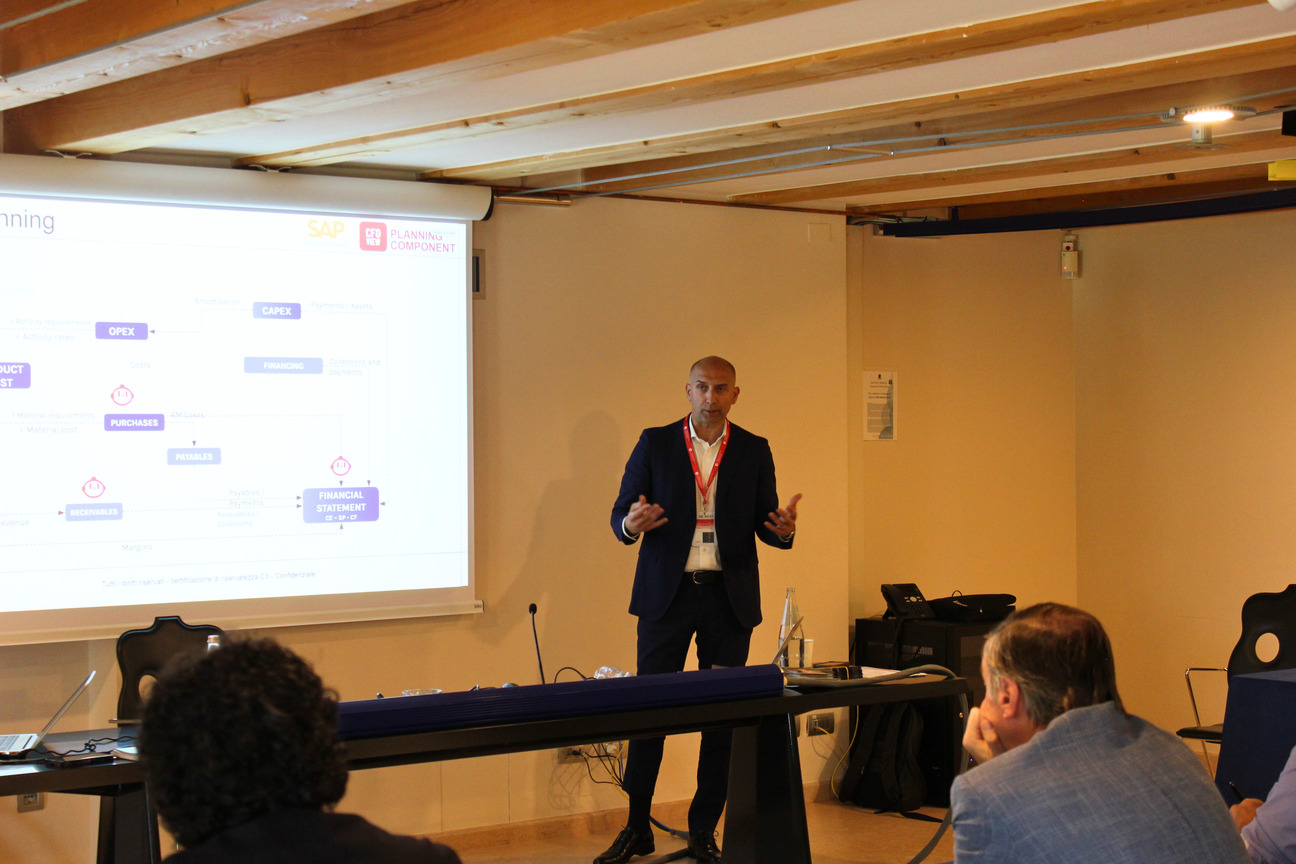
The approach we shared during RE-NEXT thus moves in the direction of more integrated governance, in which business value is observed across multiple dimensions. In this framework, technology enables predictive models, automation of data collection, greater traceability and a better ability to interpret variances. But the outcome always depends on the quality of the governance model, the definition of KPIs, and the ability of the organization to use the information at the right decision-making moments.
From the product life cycle to the factory
Among the paths of evolution, we also addressed the product life cycle, with attention to the link between design and factory. The separation between the engineering department, production assets and factory systems is still a major cause of inefficiency, loss of responsiveness and difficulties in production governance.
We put the issue operationally: the union of design and production must be complemented by a factory operating system capable of interconnecting machines, plants and information systems. A vision that takes the discussion beyond simple line digitization. A more responsive factory requires information continuity between the stages of the product life cycle: design, industrialization, production, control, maintenance and continuous improvement.
When these levels communicate, the company can reduce reaction time, improve the quality of operational decisions, and take more precise action on bottlenecks.
Here, too, data becomes the connecting point between technology and process. Gathering information from the factory, putting it in context and integrating it with management systems makes it possible to create a common decision-making basis between those who design, those who plan and those who produce. This is a necessary condition for making the smart factory a concrete operating model, and not just a sum of technologies.
Recovering the value of relationships
One of the most important aspects of RE-NEXT was the value of direct confrontation. In the pre-event communication we talked about an interactive afternoon, made up of in-depth sessions on real cases, direct discussion with managers and specialists, contributions from outstanding guests, and meeting with the Regesta network. This approach was reflected in the cut of the event: a moment designed to connect needs, experiences and perspectives.
For us, customer relationship is part of the method. Understanding how a company works, what constraints it encounters, what systems it uses, what skills it has and what goals it wants to achieve is essential to designing effective digital paths. Technology, in order to work, requires proximity: listening, analysis, the ability to enter processes and the willingness to build solutions consistent with the real context. The concluding networking had precisely the function of transforming the afternoon’s technical content into conversations, questions, exchanges, and opportunities for further study.
Business evolution comes not only from choosing a platform or introducing a new feature. It also comes from building a solid relationship between those who know the business and those who can help redesign its tools. This is why we wanted RE-NEXT to also be a relational space, open to dialogue and sharing.
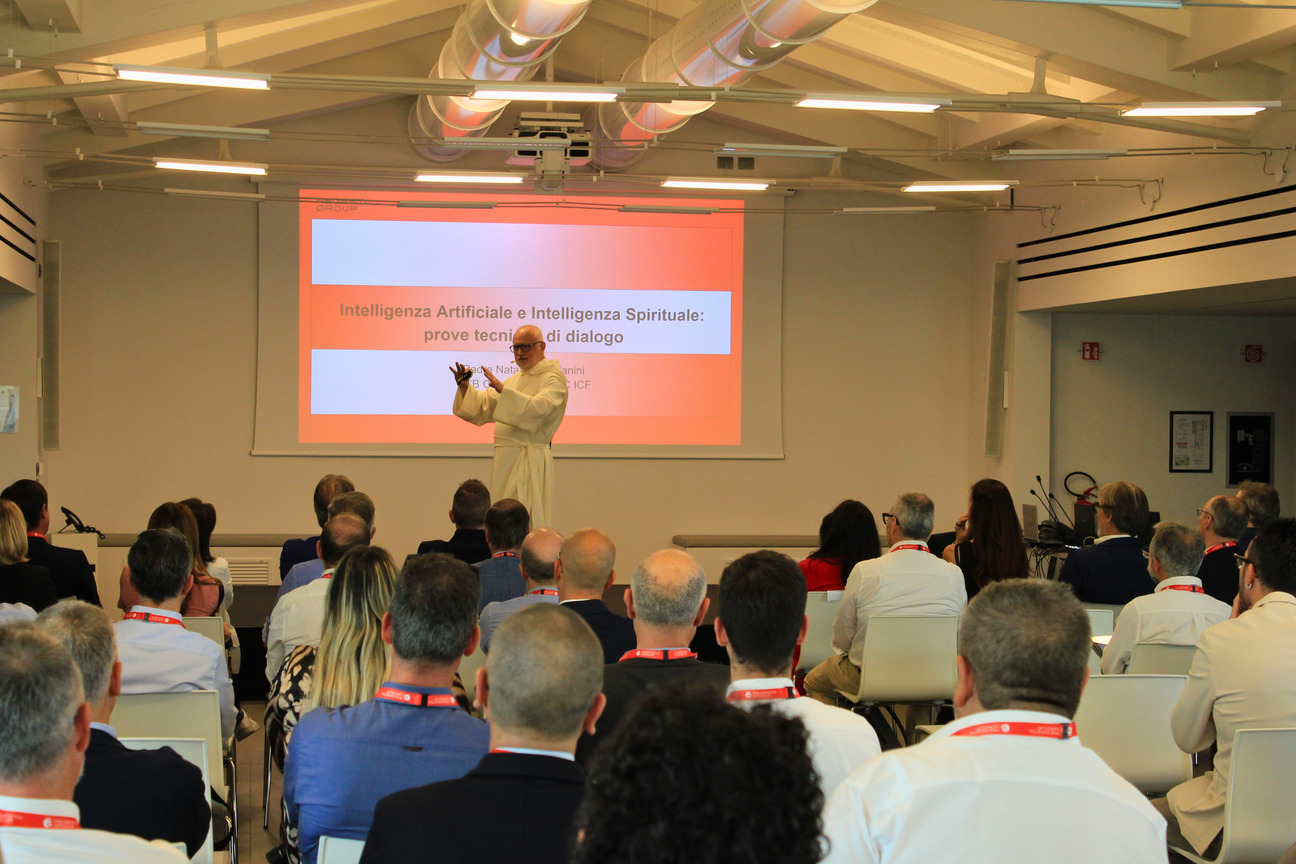
Father Natale Brescianini: the dialogue between Artificial Intelligence and Spiritual Intelligence
It is precisely on the value of people in an increasingly technological world that the talk by Father Natale Brescianini, a Life Coach belonging to the Benedictine Order who has always been concerned with the relationship between human beings and technology, fits in. In his talk, entitled “Artificial Intelligence and Spiritual Intelligence: technical evidence of dialogue,” he focused precisely on this: the human condition has always been linked to technology, but Artificial Intelligence introduces new paradigms about the speed and pervasiveness of this interaction.
In a world where Artificial Intelligence and Spiritual Intelligence must find new spaces of coexistence, what makes us truly human?
A question Father Brescianini tried to answer with the help of the audience, which was involved in the dialogue. This question also serves to redefine relationships: today many people live in a condition in which the company is also a community space, often the only one available, and this clothes them with new responsibilities regarding the value of relationships.
A starting point for new paths
With RE-NEXT we wanted to highlight a clear conviction: the evolution of the enterprise arises from the encounter between AI-enhanced digital technologies and deep process knowledge.
It is a summary that describes our role well: to provide companies with a method to govern complexity, turn data into decisions, and bring innovation inside daily operations. The official event page expresses it directly: our goal is to provide companies with the method to govern complexity, turning data into decisions and innovation into real strategic value.
The value of the event also lies in this: having created a space in which to talk about AI, data, sustainability, finance, factory and processes without artificially separating them. Because in real companies these issues are intertwined. An AI project requires reliable data. An ESG strategy requires information integration. A more responsive factory requires connection between systems. More effective governance requires shared indicators. Sustainable digital transformation requires trained, engaged and aware people.
RE-NEXT thus marked the start of a journey. An opportunity to share vision, expertise and application cases, but above all to strengthen the dialogue with companies that face the complexity of change every day. In this dialogue, we confirm our role: to support customers and partners in designing more integrated, intelligent and value-oriented digital architectures.
Want to learn more about the topics shared during RE-NEXT?
Book a call and tell our experts about your needs.
