

In the manufacturing sector, competing today means transforming data, processes, and smart technologies into faster, more accurate, and better-coordinated decisions. Smart Manufacturing and Supply Chain 4.0 address this need with an integrated model in which production, quality, maintenance, logistics, planning, and customer service all operate based on up-to-date, shared information.
This issue is currently supported by two contextual factors. On the one hand, the Ministry of Enterprise and Made in Italy’s Transition Plan 5.0¹ allocates 12.7 billion euros for the 2024–2025 period to support the digital and energy transition of businesses, with a specific allocation of 6.3 billion earmarked for the transformation of production processes.
On the other hand, the adoption of artificial intelligence in Italian companies has accelerated significantly: according to ISTAT data reported by Reuters², the percentage of Italian companies with at least 10 employees using AI technologies rose from 8.2% in 2024 to 16.4% in 2025, with 53.1% of large companies adopting these technologies. Smart Manufacturing and Supply Chain 4.0 are therefore part of an evolution already underway: integrating operational data, production processes, energy efficiency, and decision-making capabilities into a more measurable and adaptive industrial model.
The key difference, compared to traditional models based solely on technology adoption, is the ability to link operational data to the business context.
A machine alarm, a change in demand, a supplier delay, or a quality deviation are meaningful only if they can be interpreted within the context of the process: impact on the customer order, material availability, production capacity, profit margins, quality, maintenance, and service level.
This is why Smart Manufacturing and Supply Chain 4.0 are becoming a matter of corporate governance. The factory is not an isolated environment, and the supply chain is not merely the sum of suppliers, warehouses, and transportation: an end-to-end vision is needed—one capable of connecting design, planning, procurement, production, delivery, and asset management.
In our approach, this means bringing the data to where decisions are made.
It’s not enough just to collect it. It must be put into context, validated, integrated into processes, and turned into concrete actions.
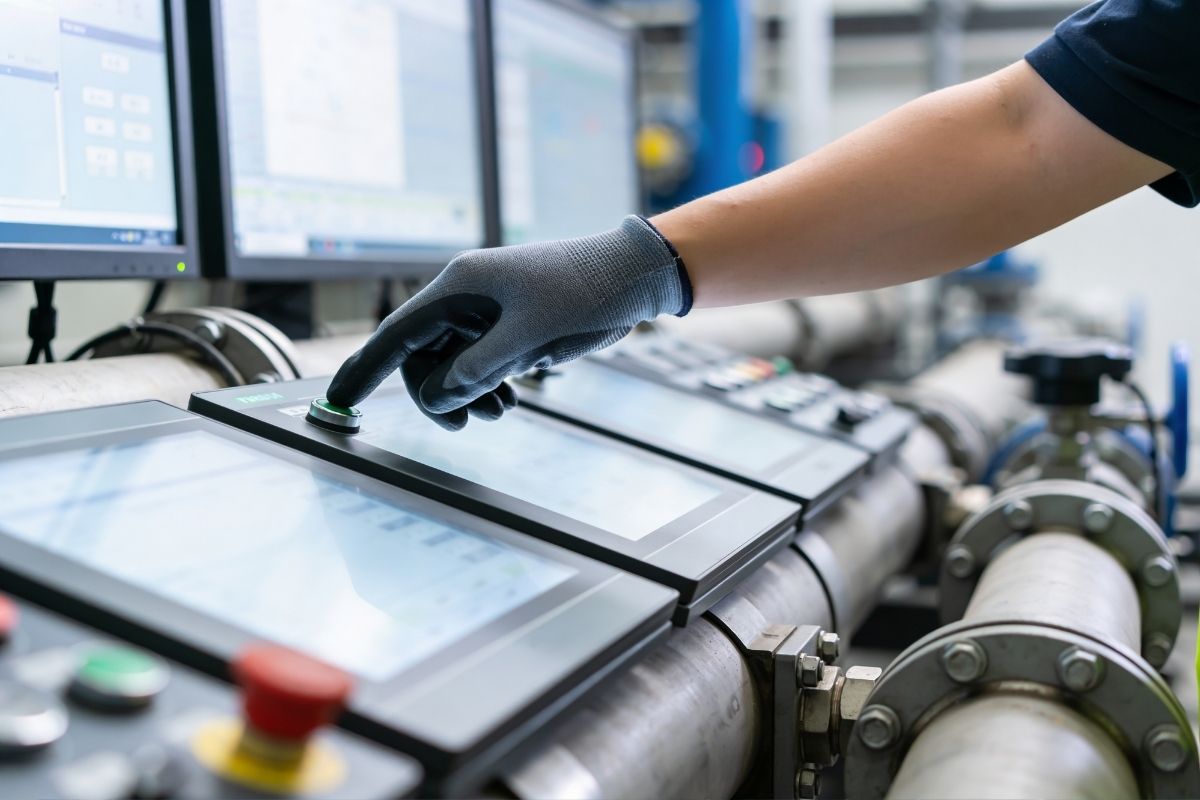
Why Real-Time Data Is the Game-Changer
The data already exists within the company: ERP, MES, PLC, quality systems, maintenance systems, and spreadsheets. The problem is almost never a lack of information, but rather its fragmentation.
When production, logistics, procurement, and planning rely on inconsistent data, the company reacts too late. An urgent order may go into production without full visibility into material availability. A machine malfunction may not trigger a maintenance response, and a supplier delay may not immediately result in a revision of the plan.
Real-time data reduces this gap between an event and a decision. It allows you to switch from a reactive management approach to a proactive one.
- IT-OT integration, to connect information systems and factory technologies;
- data quality, to avoid decisions based on incomplete or inconsistent information;
- link between technical data and process data: machine, order, batch, quality, maintenance, inventory, transportation, and customer.
From Factory Data to Supply Chain Data
The smart factory is not a highly automated island. It is a connected node in the supply chain. Its efficiency depends on its ability to exchange information with planning, procurement, logistics, quality, maintenance, and customer service.
This is why Supply Chain 4.0 transcends the separation between internal and external processes: a supplier delay, a change in demand, a nonconformity, or a maintenance decision can immediately affect production, materials, deliveries, and service levels. The integration of Smart Manufacturing and Supply Chain 4.0 allows these events to be managed as part of a single system. The goal is to bridge the information gaps between planners and producers, between buyers and shippers, and between quality control personnel and those responsible for ensuring service levels.
In short, real-time data becomes an operational tool that feeds into decision-making processes. For example, quality control can detect anomalies before they turn into recurring defects; logistics can anticipate delays and reorganize shipments.
The “Design to Operate” Model for Integrating Design, Manufacturing, and the Supply Chain
To address this complexity, a model is needed that covers the entire product and process lifecycle. The Design to Operate approach meets this need because it links design, planning, procurement, manufacturing, delivery, and operational management.
In manufacturing, many critical issues arise early on in the process. The connected factory cannot, therefore, be limited to production execution alone: it must start with product data, process rules, and cross-functional collaboration. “Design to Operate” means ensuring continuity between what is designed, what is planned, what is purchased, what is manufactured, and what is delivered. In this way, the product is no longer described by information scattered across data silos but becomes a coherent body of information.
This is particularly relevant in highly variable environments, where customization, complex production cycles, frequent changes, and distributed supply chains coexist. In these cases, technical data must be integrated with managerial and operational data. The product lifecycle becomes part of the supply chain lifecycle.
ERP, MES, PLM, and Industrial Data: Why Integration Is Crucial
Effective smart manufacturing requires an application architecture in which the various systems each serve a specific function, but their integration creates value.
ERP, MES, PLM, maintenance systems, and analytics/AI platforms play different but complementary roles. ERP governs core business processes, MES connects production to the factory floor, PLM manages product data and changes, while maintenance, analytics, and AI transform operational data into useful insights for better forecasting, monitoring, and decision-making.
When these systems are not integrated, the company risks making decisions based on different versions of reality; integration serves to establish an operational Single Source of Truth. This means creating a consistent, governed, and accessible information model. The data must be interoperable, traceable, and readable by those who need to use it.
AI and Smart Manufacturing: From Monitoring to Operational Decision-Making
Artificial intelligence applied to smart manufacturing creates value when it is linked to a real-world process, when it provides a solution to concrete problems:
- demand forecasting;
- inventory optimization;
- detection of anomalies;
- predictive maintenance;
- quality control;
- capacity planning;
- classification of materials;
- support for operators;
- Supply Risk Analysis.
A study published in 2025 on stochastic inventory optimization in large-scale supply chains³ indicates that advanced simulation and optimization models can reduce inventory levels by 10–35% while maintaining desired service levels. At the same time, advanced planning platforms such as SAP Integrated Business Planning⁴ use real-time data, AI, and advanced simulation tools to balance demand, availability, production capacity, and inventory. AI applied to the supply chain should therefore be viewed as a tool for transforming operational data into more timely decisions.
In our approach, we distinguish three main areas of application.
Forecast & Optimize
Predictive and optimization models analyze historical data, operational variables, and external data to support decisions regarding demand, pricing, inventory, production, and risk.
Visual AI
Machine vision systems detect defects, sort materials, count parts, verify assemblies, and standardize inspections that in the past depended on human judgment.
GenAI for Business
Generative tools and intelligent agents make corporate knowledge accessible, automate repetitive tasks, and support operators, technicians, planners, and back-office functions.
People’s knowledge is thus valued, documented, made available, and integrated into processes. An experienced operator can recognize a production deviation because they have firsthand experience with the production line. An AI system can help identify similar signals systematically, across large volumes of data, and more quickly. The decision remains in the hands of people, but it is supported by more timely and structured information.
Supply Chain 4.0: Planning, Resilience, and Constraint Control
The supply chain operates in an environment increasingly characterized by demand volatility, geopolitical instability, cost pressures, energy constraints, sustainability requirements, and the risk of supply disruptions. Historical data is no longer sufficient.
Supply Chain 4.0 enables more dynamic planning that combines internal and external data, simulates scenarios, and assesses the impact of decisions. Resilience stems from this ability to see and act.
Seeing means having reliable information about the entire flow, from demand to delivery. Acting means turning this information into decisions: adjusting the plan, rebalancing workloads, bringing forward a purchase, substituting a material, reallocating capacity, and updating delivery commitments.
Industrial Sustainability: Measure, Reduce, Demonstrate
Smart Manufacturing and Supply Chain 4.0 also contribute to industrial sustainability. Reducing consumption, scrap, and waste; making better use of resources; and tracking materials and their impacts all require reliable operational data. For many manufacturing companies, sustainability means, first and foremost, measurement. Without reliable data, any goal remains difficult to manage.
Industrial sustainability therefore requires the same approach as smart manufacturing: data collected from processes, integration between systems, consistent computational models, traceability, and the ability to take action.
Real-time data makes it possible, for example, to monitor consumption and deviations, reduce plant inefficiencies, verify the origin and compliance of materials, and optimize transportation, inventory, and waste. Sustainability thus becomes an integral part of the industrial process: from design to planning, from procurement to production, and all the way through to logistics.
The Role of SAP Platforms in Smart Manufacturing
To build a Smart Manufacturing and Supply Chain 4.0 model, you need platforms capable of connecting processes, data, and decisions. Along this journey, the SAP ecosystem can support companies with complementary components: SAP S/4HANA as the digital core, SAP Digital Manufacturing to connect the factory floor with management systems, SAP Integrated Business Planning for advanced planning, SAP Business Data Cloud for data governance, and SAP Business Technology Platform for integration, extensions, and automation.
The value lies not in the sum of the platforms, but in their ability to work together: a consistent database, connected production execution, integrated planning, and reliable data for analytics and AI.
The smart factory emerges from this integration: fewer silos, greater continuity between processes, and faster decision-making throughout production and the supply chain.
Smart Manufacturing: What Metrics to Track
A smart manufacturing project should not be evaluated based on the number of technologies implemented, but rather on the measurable improvement in processes. The following table summarizes some key results.
| Area | Operational Objective | Required Data | Expected Result |
|---|---|---|---|
| Production | Reduce downtime, scrap, and rework | Machine data, order progress, quality, maintenance | Greater production continuity |
| Planning | Balancing Demand, Capacity, and Materials | Forecasts, orders, inventory, lead times, production constraints | A more reliable and responsive plan |
| Quality | Detect anomalies and defects before they spread | Process data, images, batches, machine parameters | Fewer nonconformities and greater traceability |
| Maintenance | Moving from Reactive to Predictive Maintenance | Asset conditions, IoT signals, failure history, maintenance orders | Reduction in unplanned downtime |
| Supply Chain | Increase visibility and risk control | Suppliers, transportation, inventory, orders, external data | Improved operational resilience |
| Sustainability | Measuring Consumption, Waste, and Impacts | Energy, materials, emissions, transportation, processes | Better monitoring of ESG performance |
Reduction in Unplanned Downtime
This approach keeps the project grounded in industrial reality. Technology becomes an enabler, while the process remains the point of reference.
The Regesta Vision: Turning Industrial Data into Action
At Regesta, we focus on the intersection of process, data, and decision-making. Our expertise in Smart Manufacturing stems from the need to help companies better manage product development, production, quality, maintenance, and the supply chain, by integrating SAP expertise, industrial technologies, and AI solutions.
Our goal is to transform data availability into operational capability. We analyze where inefficiencies arise, where data flows are interrupted, which decisions are made too late, which activities still depend on manual checks, and which information is unreliable or does not arrive at the right time.
From there, we build a step-by-step plan. In some cases, the first step is integrating ERP and shop floor systems. In others, it’s standardizing master data and bills of materials. In still others , it’s introducing predictive models, visual inspection systems, or GenAI agents to support operational activities and corporate knowledge.
Working in a progressive manner means avoiding projects that are disconnected from the outcome. Every initiative must have clear KPIs: reducing waste, improving forecast accuracy, reducing downtime, ensuring more timely deliveries, reducing inventory, improving quality control, and speeding up the resolution of issues.
FAQ
From industrial data to decisions that drive business growth
Smart Manufacturing and Supply Chain 4.0 become truly strategic when data, processes, and technologies work together to support faster, more reliable, and more measurable decisions.
For manufacturing companies, the key step is to transform industrial data into a concrete driver of efficiency, resilience, and control—from the factory to the supply chain and all the way to customer service.
Regesta supports this journey with SAP expertise, industrial technologies, and AI solutions to build a factory that is more connected, smarter, and better equipped to make decisions.
Contact our experts and tell us about your organization’s needs.
¹ Source: www.mimit.gov.it
² Source: www.reuters.com
³ Source: arxiv.org
⁴ Source: sap.com
