

Industrial IoT, or IIoT, has been present in industry and manufacturing for a long time: in fact, the term IoT first appeared in 1999 by researcher Kevin Ashton and, contrary to what one is normally led to think, it first originated in an industrial and manufacturing context.
Only later, as the terminology spread to the consumer market, did the term IIoT catch on to refer more specifically to the industrial declinations of the Internet of Things. But what is the role of industrial IIoT in optimizing production lines today? As we shall see, its contribution is definitely important.
IoT and industry: not just energy efficiency
In the common view, the concept of IIoT is closely related to monitoring, especially energy monitoring, of machinery, plants and devices. While this is not an erroneous view, it is a highly reductive approach.
Because while it is true that industrial IoT makes it possible to considerably curb business consumption through more precise control of the energy efficiency of machinery and plants, it is also true that this is only the proverbial tip of the iceberg.
Readings and telemetry from machinery, in fact, when used in appropriately designed analysis tools, allow other particularly interesting and effective management modes to be unlocked, both from a management and operational perspective.
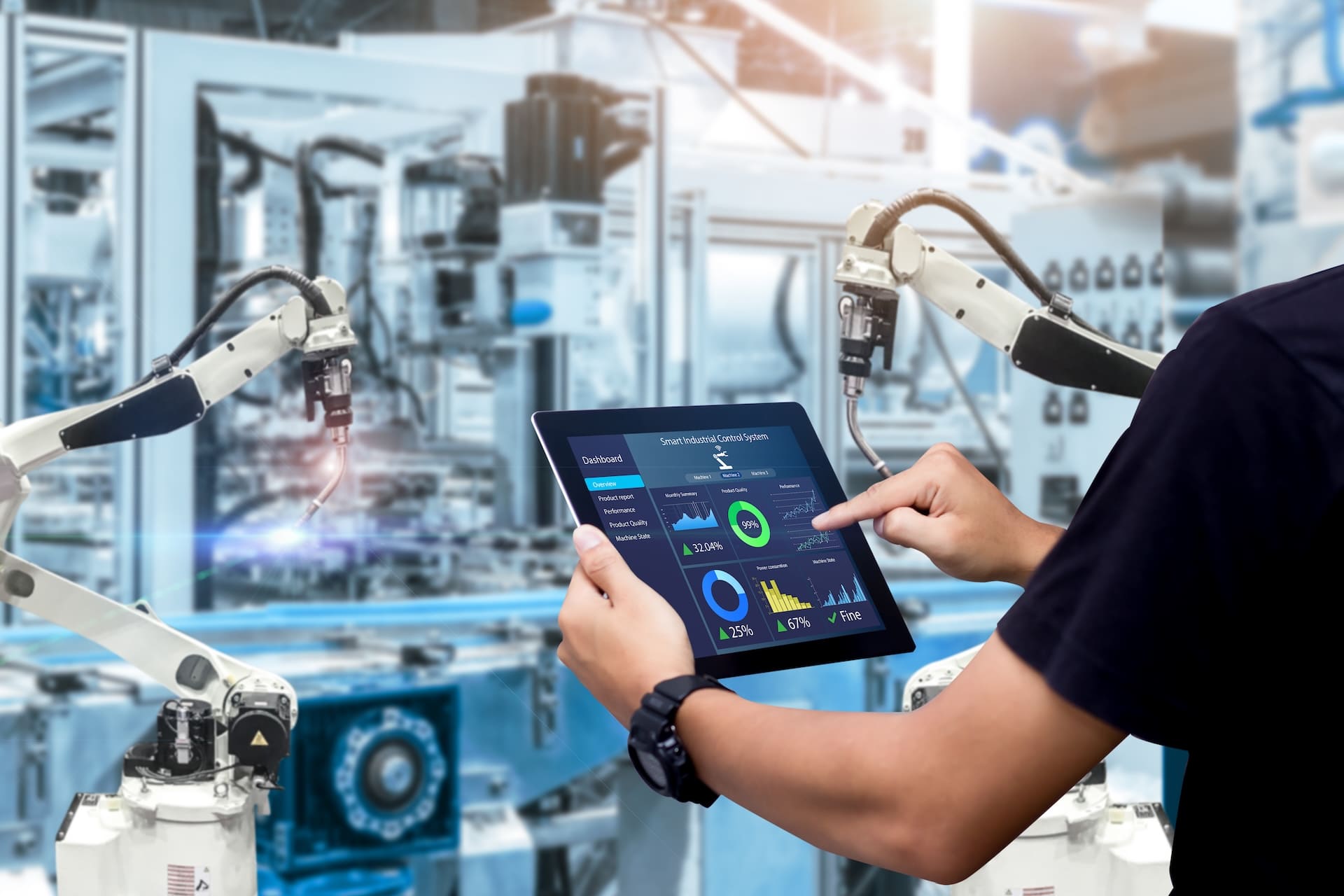
The focus is, conceptually, simple: to extend the benefits, beyond those that the data can provide in real time, by storing, analyzing and comparing it with the history acquired over time. This mode also has the advantage of solving one of the typical doubts of today’s companies, namely, how to use and put value on the data collected.
Manufacturing efficiency and IoT: the main benefits
As we have mentioned, there is at least one universally known benefit of the use of IIoT: the monitoring of energy consumption. Taking this and the other conceptually related aspects that refer to the topic of monitoring for granted, we will mainly focus on the five aspects that instead require an infrastructure and methodology for data analysis, with a special reference to production.
1. Improvement of overall efficiency
As we have mentioned, industrial IoT enables data collection and analysis. This makes it possible, through advanced algorithms such as machine learning, to analyze production in great depth and identify optimization modes that cannot be detected with traditional tools. This, combined with monitoring and the ability to quickly identify anomalies, makes it possible to reconcile highly optimized planning with the agility needed to deal with any problems that arise during production.
2. Optimized planning
For similar reasons, access to telemetry, including historical telemetry, of machinery allows for better planning, which minimizes bottlenecks, overloads and, consequently, possible slowdowns. Again thanks to the processing capacity of the data collected by IoT tools, corrections can also be made in real time, so that, again, planning and adaptability can be reconciled.
3. Reduction of processing defects
Constant monitoring of production processes makes it possible, as we have already seen in the previous points, to identify anomalies in a timely manner and quickly bring production back within the predetermined parameters. This results in higher overall quality, but not only that.
4. Reduction of scrap and processing errors.
This is a natural consequence of the previous point: if production is more uniform and more controlled, the risk of producing defective material is reduced. In addition, again through the Industrial Internet of Things, new ways of quality control can be added, for example, real-time visual inspection, so that discrepancies can be detected and corrected in an even more timely manner.
5. Predictive maintenance
Failures and breakdowns are still a major source of inefficiency within manufacturing processes. IoT sensors and detectors can provide data that, when compared with regular trends, can allow potential failures to be identified before they occur, such as through increases in working temperatures, drops in performance or other anomalies such as increases in the consumption of energy, raw materials, lubricants and so on. This makes it possible to determine how and when to intervene rather than having to take emergency action when the failure occurs.
Industrial IoT is an ally of efficient production
The role of industrial IoT in the optimization of production lines is undoubtedly a prominent one: building the right data collection capability is in fact a fundamental first step toward more efficient production, which is realized in the first instance with control and monitoring opportunities and then with the opportunity to train with its own data and specific advanced control algorithms capable of taking optimization to a new level.
Want to know which IoT solutions and tools are right for your needs?
Contact us for more information and talk to our experts.
