

The topic of integration between enterprise information systems and factory operations is one of the fundamental themes of digital transformation strategies. Although it no longer represents a cutting-edge topic in the narrow sense, it is still among the main needs of most companies today. One answer comes from SAP S/4HANA, which, in its configuration as a next-generation ERP, provides a structured view of business processes such as planning, procurement and industrial accounting.
The result of total integration is achieved through integration with a Manufacturing Execution System (MES), and in particular SAP’s approach to MES, which is oriented toward information continuity between planning and production. This makes it possible to directly govern what is happening at the production line level.
The role of MES in SAP architecture
An MES system operates at two levels: on the one hand it monitors and controls the production process in real time, while on the other it acts as an intermediate level between ERP and industrial control systems, allowing control to be integrated from raw materials to finished product. This makes it possible to translate management logic into operational instructions and, at the same time, report upward structured data from the factory.
Architecturally, MES bridges the gap between what is planned and what actually happens. SAP S/4HANA defines production goals and constraints, while the MES governs execution, making any deviation from the plan visible.
In the SAP portfolio, this function is now mainly covered by SAP Digital Manufacturing, which integrates execution, the solution SAP for MES which offers data collection and analysis in a single cloud platform.
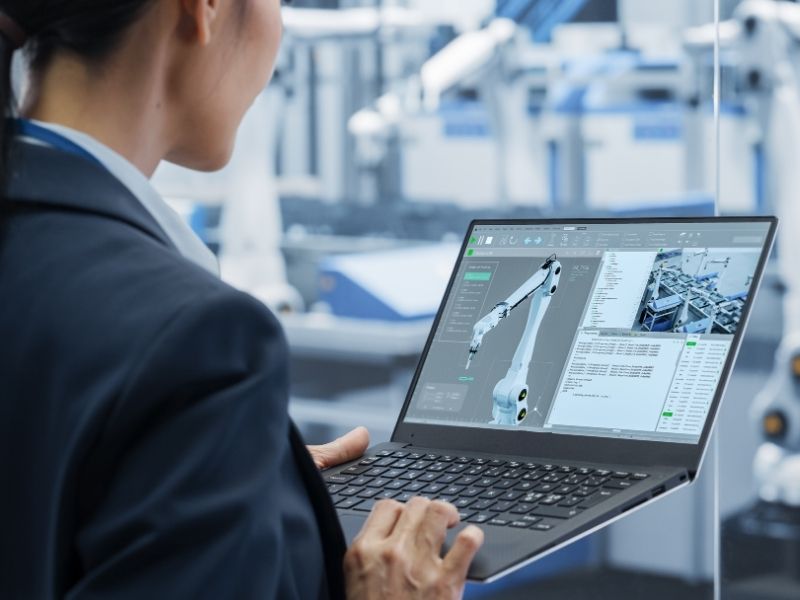
SAP S/4HANA-MES integration: operational logic
The integration between SAP S/4HANA and MES is based on a continuous, bidirectional information flow. Production orders generated at the management level are transferred to the MES, which transforms them into operational activities. During execution, the system collects real-time data on progress, performance and quality, returning it to the ERP system.
This mechanism makes it possible to build a closed loop between planning and production. Data continuously feeds into decision-making processes, where in the traditional approach it is only recorded after the fact. From a technical perspective, integration occurs through application services, shared data models, and event-driven architectures, often orchestrated through SAP Business Technology Platform. This approach reduces information latency and improves data consistency between systems.
Information continuity and data quality
One of the distinguishing features of MES integration concerns data quality. In traditional models, production information is collected manually or consolidated at the end of the shift, with inevitable delays and loss of detail. With an integrated MES, data is acquired directly from operational sources. Sensors, machines and operators feed the system in real time, generating a consistent and up-to-date information base. This provides a timely view of the production status and timely action in case of anomalies.
In this context, SAP Digital Manufacturing enables the extension of operational data to analytical and decision-making levels by integrating it with management information already present in SAP S/4HANA.
Orchestration of production processes
The evolution of advanced digital solutions has led to a move beyond the traditional concept of MES as an isolated system. Today the focus is onorchestrating manufacturing processes within an integrated architecture. SAP Digital Manufacturing represents a point of convergence between execution, integration and analysis.
The platform makes it possible to connect heterogeneous systems, collect data from industrial plants and make it available for operational and strategic control. This approach makes it possible to build a unified view of production, avoiding fragmentation between systems and reducing management complexity.
Operational benefits of integration
Integration between SAP S/4HANA and MES produces tangible effects throughout the value chain. On the operational side, the availability of real-time data enables improved production control and reduced inefficiencies. On the management level, continuous alignment between planning and production reduces deviations between forecast and actual data. At the decision-making level, the availability of up-to-date indicators allows for quick and more accurate action.
In summary, the main benefits can be traced to:
- Greater visibility and control of production processes;
- Improving quality and traceability;
- Reducing response times and inefficiencies;
- Greater reliability of industrial data;
- Support for data-driven decision-making models.
These elements form the basis for the adoption of more flexible and responsive production models that can adapt to changes in demand and complex operating environments.
Challenges in the integration between SAP and MES
The implementation of an integrated MES with SAP S/4HANA presents certain complexities that must be managed in a structured manner. The presence of legacy systems on the factory floor, the variety of industry protocols, and data quality are critical factors. An additional element concerns the alignment between IT and OT: without shared governance, the risk is to build integrations that are technically correct but not sustainable over time.
The adoption of centralized integration platforms and the definition of consistent data models are necessary conditions for ensuring system scalability.
Toward a data-driven factory
Integration between SAP S/4HANA and MES is the prerequisite for evolving toward a data-driven factory. The MES becomes the point of collection and validation of operational data, while the ERP and analytic platforms extend their use to the strategic level.
Newer architectures allow the introduction of advanced features, such as predictive analytics and simulations, based on up-to-date and consistent data. This approach makes it possible to improve planning capacity and optimize the use of production resources.
The relevance of this approach is borne out by the market: according to recent research¹, the global market for integrated MES / ERP systems is estimated to be around $80 billion in 2025, with a compound annual growth rate of 12 percent expected through 2033. Demand is driven by the growing need for real-time analytics, supply chain visibility and reduced decision latency. These are all needs that integration that find digital systems integration to be the answer.
Increasingly integrated and intelligent systems
In advanced manufacturing, integration between SAP S/4HANA and the factory is a necessary step to overcome the separation between planning and execution. MES, in its most recent evolutions, makes it possible to build information continuity involving the entire production system.
It is on this basis that more evolved operational models are developed, in which data and processes are managed in an integrated way, improving efficiency, quality, and decision-making ability.
Want to learn more?
Book a call to get more information and tell our experts about your needs.
Source ¹: marketreportanalytics.com
