

In manufacturing companies that have already embarked on a digitization journey, the issue of data availability is now outdated. The focus must shift to their actual ability to describe what is happening on the factory floor as it happens. IoT sensors, MES, ERP, quality systems and maintenance platforms are constantly generating data, often even seemingly overabundant data. The problem emerges when these remain confined to separate application domains, failing to provide a unified view of processes. In this context, formally correct indicators may arrive late, lack operational context, or fail to be actionable.
This is where the concept of Business Observability comes in, an evolution from traditional monitoring that aims to make the overall behavior of industrial processes observable by correlating events, data and performance on a continuous basis. The theme is to build a structural capacity to read the production system, similar to what happens in complex IT systems, where observability is used to understand dynamics that are not immediately obvious from distributed signals.
From measurement to operational understanding
In manufacturing and production in general, monitoring has historically been tied to established KPIs: OEE, scrap, downtime, adherence to production schedules. These indicators remain critical, but they show obvious limitations when the manufacturing environment becomes more variable, with small batches, high product mixes, and less predictable supply chains. In these scenarios, knowing that an indicator is out of line is not enough if there is a lack of ability to quickly reconstruct why.
Business Observability introduces a change in perspective: instead of evaluating individual indicators in isolation, it monitors the behavior of processes over time and relates events of a different nature. A delay in production may be related to a BOM change, an anomaly on a supplier, a change in machine parameters, or a planning decision made days earlier. Without a unified view, these relationships remain implicit and difficult to identify.
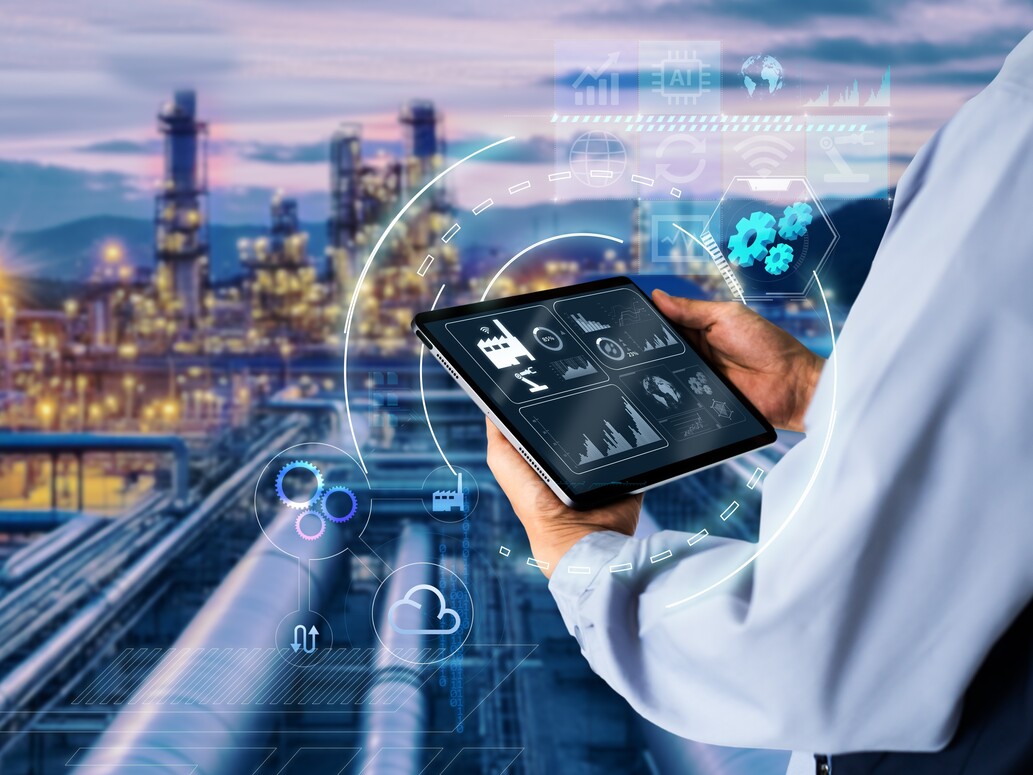
From a technical point of view, this requires three elements: continuous access to operational data, the ability to correlate across domains, and a consistent information model that allows signals to be interpreted from a process, not an individual application, perspective.
The smart factory as a complex observable system
The smart factory is often described as a collection of connected technologies. In reality, it is a complex system in which local decisions produce global effects. The introduction of advanced automation, collaborative robotics and advanced planning increases efficiency but makes cause-and-effect chains less linear. In this scenario, observability becomes an indispensable and vital condition for maintaining control.
An observable system makes it possible to answer questions beyond simply what happened: when a line slows down, it is possible to understand whether the source is a capacity constraint, a scheduling choice, an upstream quality problem, or inconsistent master data. This capability reduces the time needed for analysis, improves the quality of decisions, and makes coordination between production, maintenance, logistics, and planning more effective.
Unlike traditional models based on already crystallized (and often out-of-date) data, here the focus shifts from report logic to continuous reading of the state of the system. Data are not only aggregated for management, but made usable to operational roles with the necessary level of detail and context.
The role of an industrial operating system
To make Business Observability viable, an infrastructure is needed that overcomes the logic of point-to-point integrations and application silos. This is where Bishop fits in, conceived as an industrial operating system capable of orchestrating data, events and processes along the entire value chain.
Bishop is the operating system for the smart factory, which does not replace existing systems but connects them to a higher level of governance. ERP, MES, automation systems and analytics platforms continue to play their roles, while Bishop intercepts the relevant signals, normalizes them and relates them according to a process logic. This approach makes it possible to build a coherent view of factory operation while maintaining the link to the real data.
Architecturally, the value lies in the ability to handle events in real-time, track information lineage, and maintain shared semantics across domains. This makes it possible to identify operational patterns, anticipate critical issues and assess the impact of decisions before they result in measurable inefficiencies.
From observability to action
A distinctive aspect of Business Observability applied to the smart factory is its operational focus. The goal is to make data actionable: accumulating knowledge becomes an intermediate step toward the ultimate goal, supporting action. When an anomaly is detected, the system must provide sufficient elements to decide how to intervene, indicating where the problem originates and what processes are involved.
In Bishop, this logic translates into the ability to navigate the data along the process, always in continuity between event, context and decision. A production manager can analyze a deviation by starting with the end result and going back to the operating conditions that generated it, without having to manually query different systems or reconstruct the information flow after the fact.
This approach has direct effects on operational resilience. In contexts characterized by variability and uncertainty, the ability to read system behavior in a timely manner reduces the impact of unforeseen events and improves adaptability. Observability thus becomes an enabling factor for more flexible production models.
An evolution consistent with the Regesta vision
Within Regesta’s journey, Business Observability represents a natural evolution of the themes of process integration, data governance and decision support. Experience in ERP, manufacturing and analytics converges in a vision in which technology is always a tool to make industrial complexity readable.
Bishop, made by Ultrafab, a Regesta Group company, fits into this framework as a platform capable of translating heterogeneous data into operational information while maintaining a balance between structure and adaptability. It does not impose rigid models, but provides a framework on which to build a progressive observational capability aligned with the organization’s digital maturity.
In a smart factory, the difference between reaction and anticipation comes down to the quality of system reading. Business Observability, supported by an industrial operating system, allows the focus to shift from simply measuring performance to deeply understanding processes. It is in this space that the ability of manufacturing companies to govern complexity without sacrificing efficiency and control is at stake.
Do you want to know more?
Contact us for more information and tell our experts about your needs.
