

Analyzing technical specifications, verifying a product’s compliance, or searching for information scattered across various documents and company systems are tasks that require specific expertise, time, and access to reliable information sources. In many cases, a significant portion of the work involves retrieving data that is already available, interpreting it, and correlating it with the information contained in the ERP system or technical documentation.
The applicationof artificial intelligence in business processes makes it possible to streamline these activities and provide people with tools capable of understanding requests formulated in natural language, consulting various sources, and supporting the execution of structured operations. However, the shift from generative AI used as a personal assistant to agents integrated into information systems introduces new requirements for governance, security, and control over results.
It is in this context that we developed Reggy, Regesta’s AI Digital Worker: a solution based on specialized AI agents, designed to leverage business knowledge and interact with management applications. Its goal is to make artificial intelligence an operational tool, applicable to concrete tasks such as analyzing specifications, verifying technical compliance, managing documents, and supporting commercial and administrative processes.
From the Problem of Distributed Knowledge to Artificial Intelligence in Business Processes
To understand the possibilities offered by AI Digital Workers, we can start with a common scenario in manufacturing companies.
A customer submits a request for a quote, accompanied by technical specifications that include product details, performance requirements, and references to industry standards. Before preparing a proposal, the company must verify which products in its catalog meet the required characteristics, identify any discrepancies, and evaluate alternatives.
This is a complex task because the necessary information is scattered across different documents. The requirements are described in the specifications, the product characteristics in the technical data sheets, the applicable provisions in the relevant standards, and the commercial data in the management systems.
The problem, therefore, is not in finding information, but in interpreting it, connecting the dots, and applying it in a specific context—often by drawing on the expertise of a few people who have in-depth knowledge of the company’s products and procedures.
This reliance on individual knowledge has implications for efficiency. Preparing proposals can take days of work, experts are diverted from other tasks, and the risk of overlooking a requirement increases as the documentation becomes more complex. Furthermore, when expertise is not properly structured, employee turnover can result in a loss of knowledge that is difficult to recover.
This is just one example, but similar problems exist in many other areas: maintenance, order management, and administration. The information is there, but using it requires human intervention to establish the relationships between data, documents, and procedures.
Artificial intelligence can help reduce this workload, provided it is integrated with business knowledge and systems. A generative language model can, in fact, interpret a document and generate a response, but to verify a technical requirement, it must be able to access the correct sources, understand the relationships between them, and distinguish between available and missing information.
Reggy: a digital assistant integrated with the ERP
The concept of the AI Digital Worker stems from the need to move beyond the conversational assistant model and introduce tools capable of performing specialized tasks within operational workflows.
An AI Digital Worker is a software agent that uses artificial intelligence technologies to interpret requests, retrieve information, apply procedures, and interact with business systems. Depending on its assigned functions and permissions, it can prepare documents, perform analyses, or carry out operations on integrated applications, while maintaining human oversight of activities that require it.
Reggy is designed to integrate into business processes and function as a specialized digital assistant, with features that set it apart from a traditional chatbot.
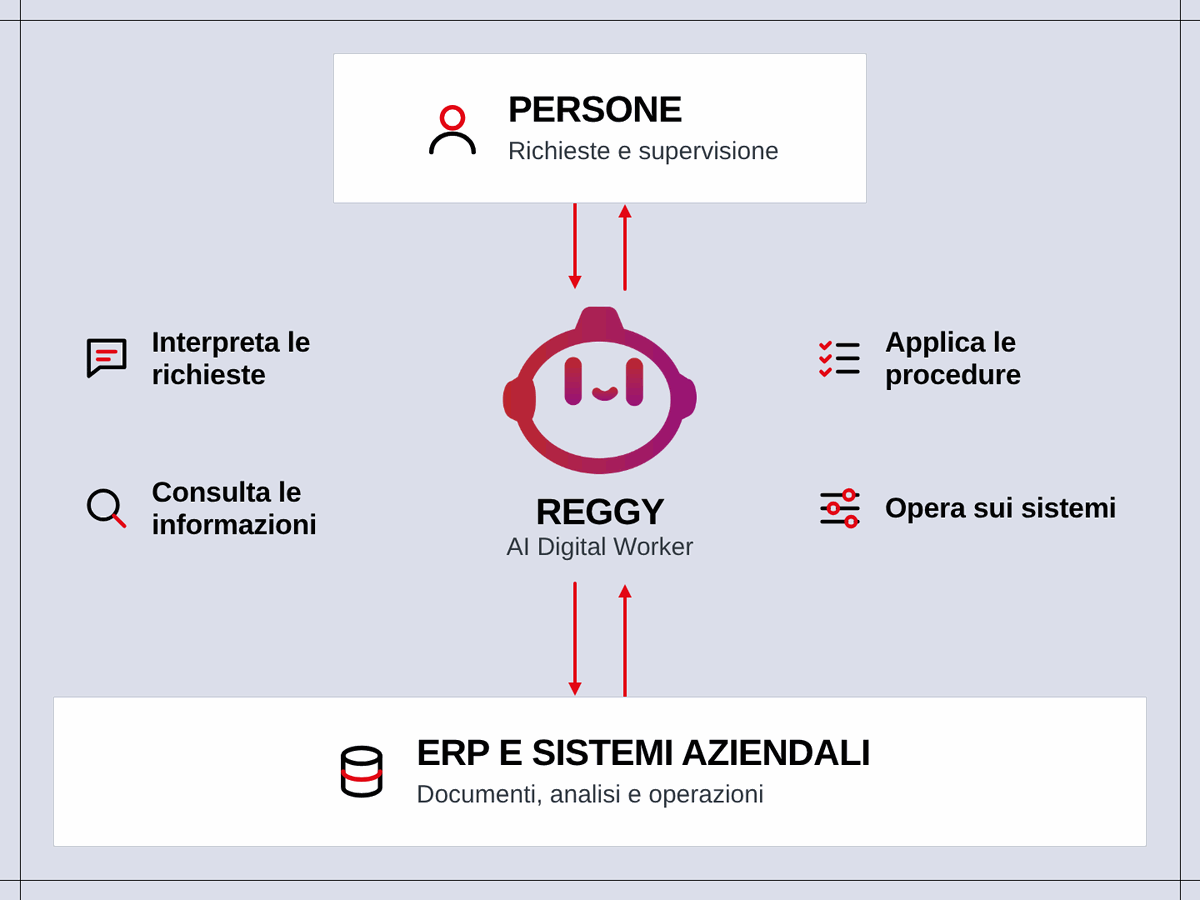
The first concerns the methods of interaction. Reggy can communicate through various channels, including chat, email, and phone, allowing people to use the tools best suited to their work.
The second point concerns the context. The system is designed to recognize the user’s identity, their role within the company, and their associated permissions, in order to restrict access to authorized information and operations.
Another key feature is integration with the ERP system, which allows agents to use management data and, when permitted by the configurations and permissions, perform read and write operations.
The most significant aspect, however, is the link between the interpretive capabilities of generative AI and semantic knowledge bases, which make it possible to leverage the relationships between documents, products, requirements, and technical standards to perform tasks that require an understanding of the business context.
In practice, Reggy is not used to provide general answers to questions, but to perform specific tasks with clearly defined information sources, procedures, and responsibilities.
How to Apply Artificial Intelligence to Business Processes: Reggy’s Roles
Reggy
‘s
architecture allows for the development of AI agents with different capabilities, each dedicated to a specific operational area.
We have organized these applications according to Reggy’s job role concept, assigning a set of business activities to each agent.
| AI Agent | Supported Activities |
|---|---|
| Tender Analyst | Analyzes calls for bids and requests for proposals, comparing requirements with technical documentation and preparing lists of discrepancies. |
| Compliance Assistant | Verifies product compliance with applicable requirements and technical standards. |
| Inbound Document Processor | Reads documents such as delivery notes and invoices and links them to orders in SAP. |
| Technical Assistant | Assists maintenance technicians in diagnosing problems and consulting technical documentation. |
| Order Assistant | Prepares draft quotes based on quote requests. |
| Sales Assistant | Assists with updating the CRM through voice interactions. |
| Insight Assistant | Interprets data from Business Intelligence reports and provides contextual analysis. |
| Cash Assistant | Analyzes financial information and suggests possible actions to support the CFO. |
| Foresight | Analyzes historical data and produces forecasts. |
| People Assistant | Responds to staff inquiries regarding company policies and procedures. |
| Inspector | Supports visual inspection of product quality using AI technologies. |
These applications demonstrate how artificial intelligence can be used in a wide variety of tasks, all based on a common logic: providing the agent with the necessary information, defining the tasks it can perform, and integrating the results into the existing process.
To gain a deeper understanding of how this model works, we can focus on two applications: Reggy Tender Analyst and Reggy Compliance Assistant.
Reggy Tender Analyst: From analyzing bid specifications to preparing bids
Analyzing requests for proposals is a particularly interesting task because it combines the interpretation of complex documents with the need to produce technically verifiable results.
A bid specification may contain hundreds of requirements and numerous regulatory references. For each requirement, the engineering department must identify the required characteristics, compare them with those of available products, and pinpoint any differences.
Reggy Tender Analyst automates a significant portion of this work through an architecture that combines semantic understanding, ontologies, and knowledge graphs.
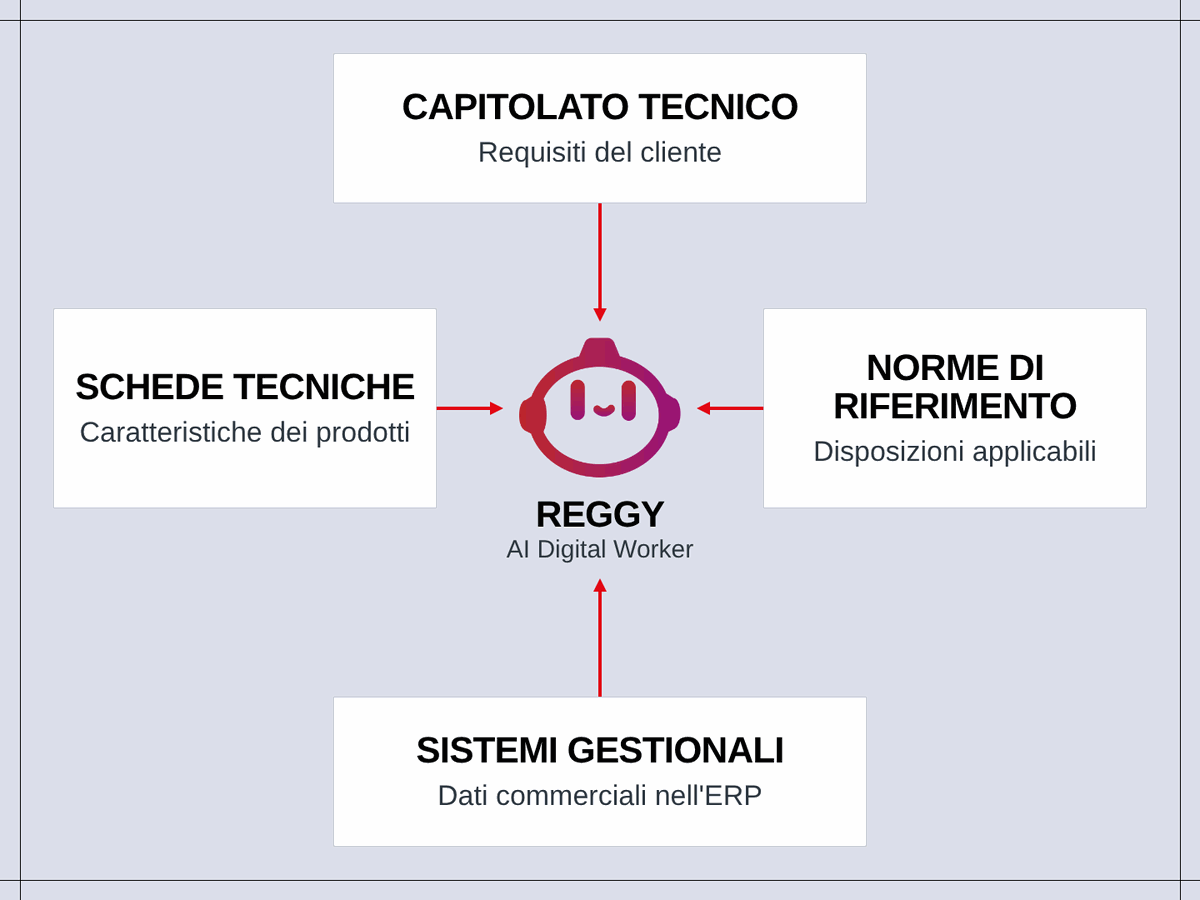
The first step involves defining an ontology—that is, a model that describes the entities relevant to the analysis and the relationships that may exist among them. In the case of a specification, these entities may include requirements, technical parameters, standards, and products.
The quality of this model is important because it determines what information the system can recognize and how it can link that information.
Next, the AI analyzes the document and extracts elements from it according to the defined structure. The information is organized into a knowledge graph, in which requirements, standards, and products are linked through explicit relationships.
The difference compared to a simple text search is significant. A requirement may be phrased differently than it is in the product sheet, or it may refer to a standard that introduces additional conditions to be verified. The graph allows this information to be treated as interconnected elements, rather than as independent texts.
Based on the knowledge base, a linguistic model compares the requirements and related standards with the characteristics of available products, identifying possible matches and discrepancies.
The result is a deviation list—that is, a structured list of the differences between the requested specifications and the characteristics of the bid—accompanied by an indication of the products that are potentially the most suitable.
The technical department can thus focus its efforts on evaluating discrepancies, verifying information, and making decisions that require specialized expertise, rather than spending most of its time searching for and manually reconstructing data.
Reggy Compliance Assistant: Verifying Product Compliance
A second area of application concerns technical compliance.
For companies operating in regulated sectors, verifying whether a product meets specific requirements involves comparing technical characteristics, applicable standards, and available documentation. The task becomes particularly challenging when the catalog contains numerous product listings or when a product must comply with different regulations depending on the market or sector of use.
Reggy Compliance Assistant uses a semantic knowledge-based approach to link requirements, regulations, and product characteristics. The system can analyze a set of specifications or technical specifications, extract the relevant requirements, and compare them with the information available in the catalog.
The knowledge base makes it possible to explicitly document the relationships between sources, making it easier to trace the path followed during the analysis.
The goal is to support two related activities: verifying a product’s compliance with the required specifications and identifying any instances of non-compliance or missing data. In this regard, the AI Digital Worker helps make the analysis more systematic, without replacing the company’s technical and organizational responsibilities.
How to Introduce an AI Digital Worker into Business Processes
The experience gained in developing Reggy highlights a methodological aspect: to effectively introduce AI agents into a company, it is best to start with a well-defined task—one for which the operational procedures, information sources, and expected results are known. In short, it is necessary to understand which tasks are the most time-consuming, what information is used, which decisions require human intervention, and which operations can be entrusted to a software agent. The goal is to identify a use case that is sufficiently well-defined to be tested under real-world operating conditions.
When defining Reggy’s operational scope, a particularly important consideration concerns errors. The AI must also be evaluated based on its ability to flag missing information, inconsistencies, and situations in which it lacks sufficient data to reach a reliable conclusion.
The same applies to ERP integration. Any data entry operations must be limited to authorized functions and accompanied by the necessary controls, especially when they affect administrative, commercial, or production processes.
This approach makes it possible to distinguish between the technical capabilities of artificial intelligence and the value that can actually be achieved within a specific organization.
From Accessing Information to Performing Tasks
Artificial intelligence in business processes opens up the possibility of leveraging a company’s knowledge base to support tasks that, until now, required numerous manual steps. The difference from generative AI, in general terms, is that these processes can be linked to information and workflows. With Reggy, we’ve translated this approach into a family of specialized AI Digital Workers, designed to handle different tasks through a common architecture.
An analysis of specifications and product compliance verification demonstrate how the combination of language models, semantic knowledge, and application integration can make complex processes more efficient while maintaining the ability to verify results.
In this context, the value of artificial intelligence depends on its ability to transform available information into actionable and controllable tasks. It is on this relationship between knowledge, processes, and accountability that the use of AI agents in companies is built.
Do you want to implement an effective AI strategy in your company?
Talk to our experts and find out which solutions are right for your needs.
